
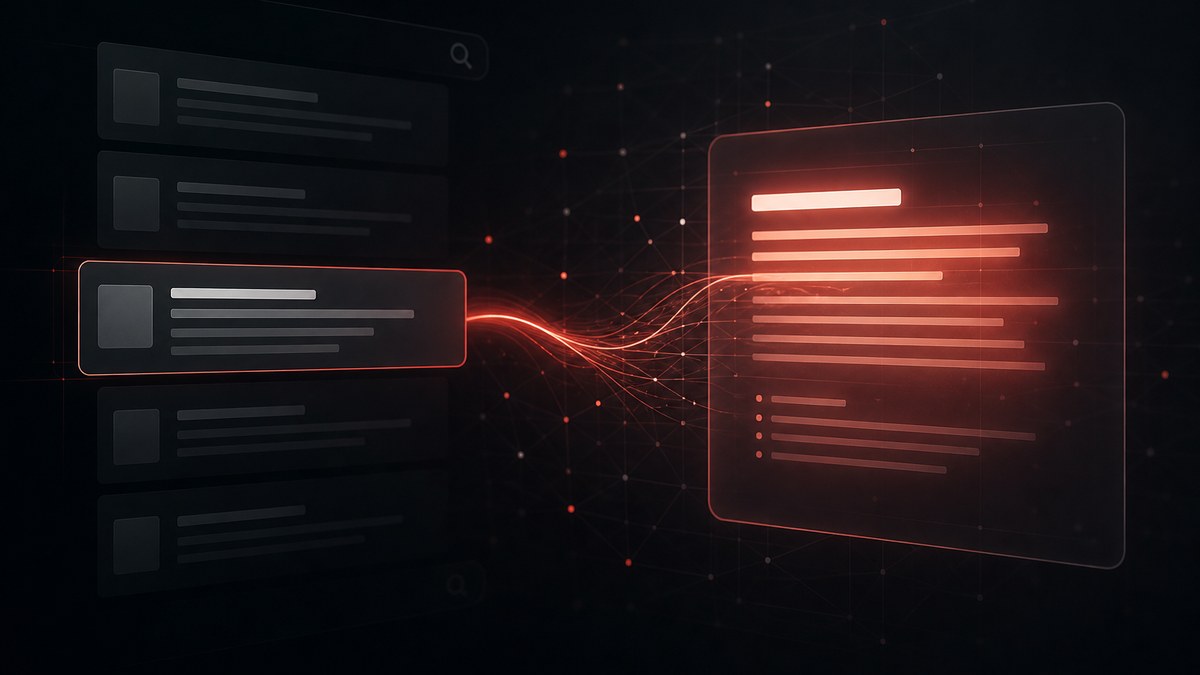
Continuity and difference: snippet vs AI answer
A featured snippet is a single-source answer box at the top of results. An AI answer (Google AI Overviews, ChatGPT, Perplexity) goes further: it synthesizes several sources into new text. Both reward the same thing — a direct, short, structured answer. That is why snippet-ready copy is the best starting point for AI adaptation. For the conceptual frame, see What is AEO vs GEO.
The difference is synthesis. A snippet lifts one block; an AI answer scans the topic’s meaning space. A 40-word box for one query is not enough. If your brand is not modeled as the authority on that topic, you can win the snippet and still be absent from the AI answer. For the AIO technical base, read How to become a source in Google AI Overviews.
Mindset shifts too. In the snippet era, success was winning the box and the click. In the AI-answer era, users often read the answer first; the brand appears as a citation. Traffic can fall while topic authority, recall, and trust still accumulate. Measurement moves from “how many clicks” to “on which questions are we cited.”
Snippet type → AI format mapping
Do not delete the snippet format. Add a layer AI can extract.
| Snippet type | Keep | AI layer |
|---|---|---|
| Paragraph (definition) | 40–60 word opening | Definition + scope + limits + related entities |
| List / HowTo | Numbered steps | Rationale, risk, and alternative on each step |
| Table | 2–4 column comparison | A decision rule: when to pick which |
| FAQ box | Question–answer pairs | Follow-ups and People Also Ask coverage |
AI systems want extractable HTML: semantic headings, a short definition, lists, tables. Visual-only or JS-painted answers lose both snippets and citations.
Snippet block first, then an AI-ready block
Apply this template to existing snippet pages. The first block is for snippets / AEO; the rest feeds GEO synthesis.
- Answer sentence: 1–2 sentences, 40–60 words, no question echo.
- Scope: Where the answer holds (B2B, local, YMYL, product type).
- Depth: Two or three angles — cost, risk, alternative, example.
- Proof: First-party data, a dated source, or a method note.
- Next question: The natural follow-up (from PAA).
Example spine: “What is GEO?” → short definition → difference from SEO → who applies it → how you measure it. The definition box holds the snippet; difference and measurement feed AI synthesis. See our What is GEO guide for the core definition.
Entity and schema checklist
AI answers join concepts by consistent names. If “GEO”, “Generative Engine Optimization”, and “AI SEO” are not bound as one entity, synthesis fragments. Use our entity SEO guide.
- Spell brand, service, and concept names the same way throughout (aligned with Organization / sameAs).
- Article + FAQPage; HowTo on step content; sensible ItemList / table semantics on comparisons.
- Show author, updated date, and source links — E-E-A-T is readable in AI citation too.
- Put the target entity in the first 100 words; keep H2s in question form.
A People Also Ask follow-up map
A snippet wins one question. An AI answer merges the family around it. Pull 8–12 follow-ups from Search Console, PAA, and competitor AI answers; bind each to an H2 or FAQ row. A “what / how / when / difference / risk” set covers most informational topics.
The goal is not a bloated page. It is closing the meaning space. One pillar plus linked clusters beats fourteen thin repeats of the same entity for both snippets and citations.
AIO, ChatGPT, and Perplexity will not share one paste
All three like a clear answer; citation behavior differs.
- Google AI Overviews: Indexed, technically healthy pages. Organic quality is still the door.
- Perplexity: Visible source lists; freshness, comparisons, and first-party data rise.
- ChatGPT (search / browse): Entity authority and a consistent brand story; one box is not enough — you need the topic family.
So “write snippet HTML once and stamp it everywhere” fails. Keep the same answer core; weight proof and follow-ups to platform intent. For implementation, see our GEO service.
Measurement: winning the snippet is not enough
Keep two scorecards. Old card: featured-snippet visibility, PAA wins, organic clicks. New card: citation rate on a target prompt set, brand name in the answer (answer share), source link, and competitor share. Combine Search Console AIO impressions when available; ChatGPT/Perplexity need a monthly prompt panel.
A click drop is not automatic failure. If source visibility rises across the question set, the content is working as an asset. The reverse is also true: snippet without citation means depth, entity, or trust is missing — return to the format map.
90-day implementation roadmap (summary)
- Days 0–30: Inventory snippet-winning URLs; mark format-mapping and entity gaps
- Days 30–60: Ship the answer-first template, PAA map, FAQPage/HowTo, and proof layer
- Days 60–90: Measure citations on an AIO + ChatGPT + Perplexity prompt panel; scale the template
Frequently asked questions
Does winning a featured snippet guarantee an AI-answer citation?
No, but it is a strong base. Both reward clarity and structure; AI answers also want synthesis, entities, and trust. If you have the snippet but no citation, add depth and sources.
If clicks are falling, should we still target snippets?
Yes. The same clear-answer spine is the raw material for AI citation. Value is no longer clicks alone — it is showing up as a trusted source on the question set.
Which snippet format adapts best to AI answers?
A definition paragraph plus a short list travels furthest. Comparison tables are cited often in Perplexity and AIO. HowTo steps without rationale produce a thin AI summary.
Do we have to rewrite existing posts from scratch?
Usually not. Lock the opening answer; add scope, proof, PAA, and schema. Making the page extractable is faster than a full rewrite.
Does adaptation work without schema?
The copy can still be read, but FAQPage/HowTo and consistent entity marks help AI join the block to the right context. Schema is not magic; it lowers extraction cost.
How many follow-up questions are enough?
On an informational pillar, 8–12 high-intent follow-ups are usually enough. Close them as H2/FAQ on the same page; spin out only queries with a distinct search intent.
Conclusion
Featured-snippet work is not the opposite of the AI-answer era — it is the first layer. Keep the clear opening; add depth, entities, PAA, and a measurable citation target. Content then becomes a citable source for the topic, not a single box.
At Mizemedia we support this end to end. Learn more on our GEO / AI visibility service page, request a free quote, or contact us.
Related guides: