
Buyers and decision-makers increasingly start their journey on ChatGPT, Google AI Overviews, or Perplexity — not on a traditional Google results page. Questions like "best digital agency," "what is GEO," or "corporate website pricing" get answered in one AI response. If your brand is not there, your competitor is. This guide explains how search habits are changing, what Generative Engine Optimization (GEO) means, how it differs from classic SEO, and the technical and content steps you can apply on your website.
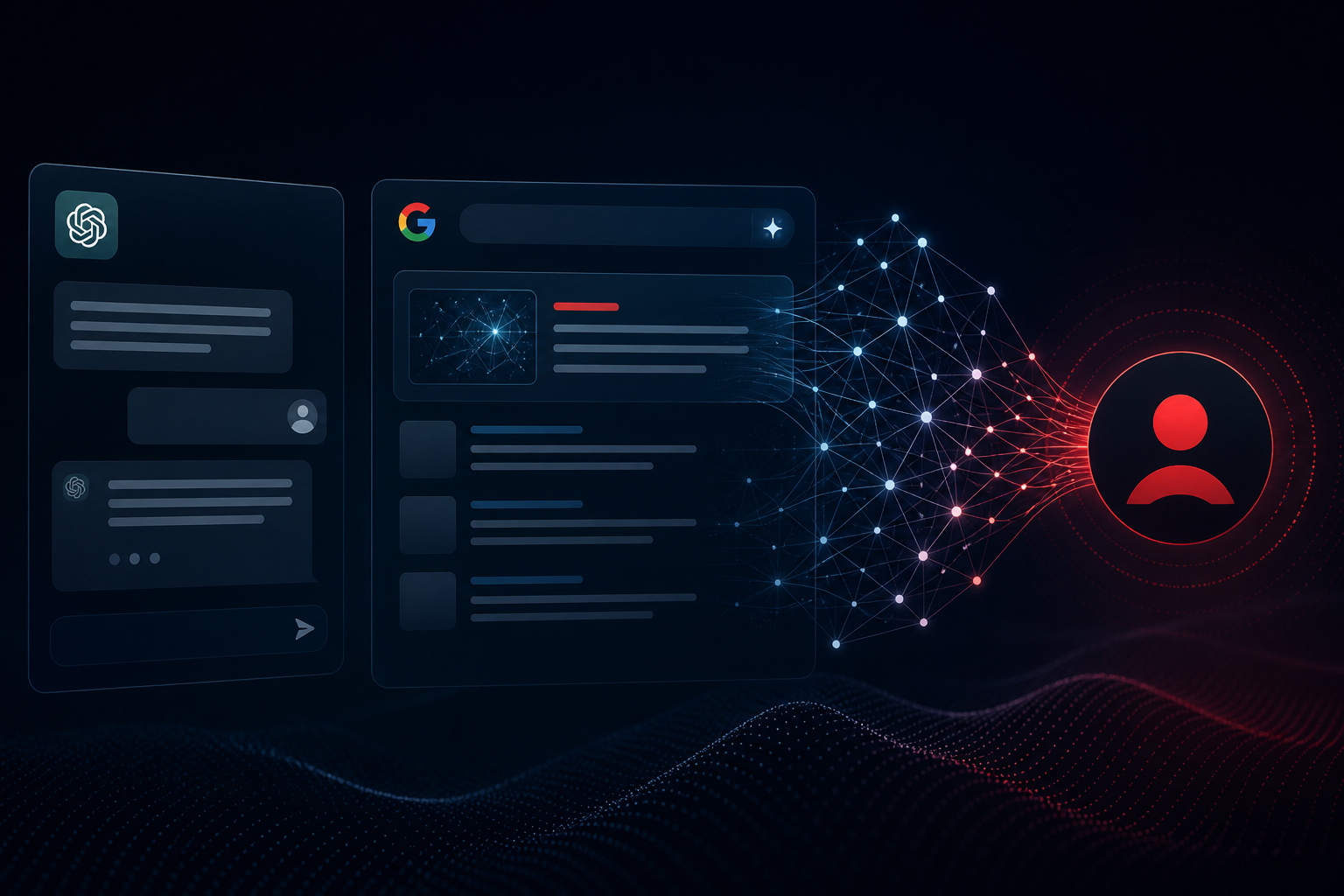
How search habits are changing
A few years ago, users typed keywords into Google, clicked blue links, and compared a handful of sites. Today, especially for research-intent queries, behavior looks different:
- Rising zero-click: Google AI Overviews summarize answers on the results page, reducing the need to click through.
- Conversational search: On ChatGPT and Gemini, users ask full questions and follow up — moving away from classic keyword logic.
- Source trust: When a brand name or source link appears in an AI answer, that site gains authority in the user's eyes.
- B2B decision flow: Marketing directors and business owners start vendor research with AI assistants; the first shortlist often forms before Google.
This shift means marketing budgets must allocate to AI search visibility, not only organic rankings. For broader context, read our Is SEO dying? AI search era guide and AI Search and GEO strategy insight.
Why visibility on ChatGPT, Google AI Overviews, and AI search matters
AI search may not yet drive the majority of traffic, but its impact is disproportionately large:
- Brand perception: A brand recommended in an AI answer creates a "market leader" impression — especially in B2B services.
- Competitive displacement: If you are absent, your competitor fills the gap. Users build their shortlist from AI responses.
- Branded search trigger: Users who see your brand in ChatGPT often search your name on Google next — indirect organic uplift.
- Perplexity and direct traffic: Perplexity shows numbered source links, enabling direct visits from AI.
In 2026, AI SEO is no longer experimental; in competitive sectors it is a standard visibility layer. Our ChatGPT and Perplexity brand visibility guide covers platform-specific tactics.
What is GEO (Generative Engine Optimization)?
What is GEO? Generative Engine Optimization is the discipline of positioning brands as citable, trustworthy sources in AI-powered search and answer engines.
GEO includes:
- Entity SEO: Consistent brand definition via Organization/Person schema, NAP consistency, social profiles, and directory mentions.
- Schema markup: Article, FAQPage, HowTo, BreadcrumbList — structured reading for crawlers.
- Answer-first content: 40–60 word definition paragraphs, lists, and tables that directly answer questions.
- Topical authority: Pillar pages plus cluster articles that build subject expertise.
- AI bot policy: Intentional robots.txt rules for GPTBot, OAI-SearchBot, and Google-Extended.
- Digital PR: Brand mentions and sector authority signals.
For the full framework, read our What is GEO? 2026 guide. For implementation, explore our GEO solutions.
GEO vs classic SEO: key differences
The most common misconception: does GEO replace SEO? No — they target different outputs but share infrastructure.
| Dimension | Classic SEO | GEO (AI SEO) |
|---|---|---|
| Goal | Organic rankings, clicks | Citations and brand mentions in AI answers |
| Metrics | Rank, CTR, organic traffic | Citation rate, share of voice, branded search |
| Platforms | Google, Bing organic | ChatGPT, AI Overviews, Perplexity, Gemini |
| Content format | Keywords + UX | Extractable, answer-first, schema-supported |
| Technical base | Index, speed, mobile | Same + AI bot access + entity consistency |
| Time horizon | 3–6 months for rankings | 1–3 months for early citation signals |
Building GEO without SEO is like adding a roof without a foundation. Index, technical health, and site authority matter for both. See our Is SEO dying? article for a wider perspective.
How AI systems evaluate brands and sources
Each platform uses different retrieval layers, but evaluation signals overlap:
1. Domain and entity authority
AI models tend to treat brands as entities, not word strings. Consistent naming, Organization schema, knowledge-panel-like signals, and sector directory mentions build trust. Conflicting definitions across pages weaken the entity graph.
2. Content freshness and depth
Perplexity and Google AI Overviews weight recency. ChatGPT looks for topical depth — comprehensive clusters on a subject. Pillar content with visible "last updated" dates and regular revisions performs better.
3. Extractable format
AI prefers extractable paragraphs over walls of text: definition sentences, numbered lists, comparison tables, FAQ blocks. Sentences with statistics are more likely to be cited.
4. External ecosystem signals
Brand mentions (linked or unlinked) matter as much as backlinks. Podcast show notes, industry reports, speaker lists, and press releases feed the entity graph.
5. Crawler access
Sites that fully block GPTBot or Google-Extended in robots.txt are closed to AI indexing. Use separate disallow rules for sensitive pages; keep public content accessible.
Technical and content optimization on your website
Technical checklist
- Server-side rendering (Next.js SSR/SSG) for clean HTML — AI bots crawl JS-heavy pages inefficiently.
- Core Web Vitals targets: LCP < 2.5s, INP < 200ms.
- Up-to-date XML sitemap; noindex pages excluded.
- robots.txt: strategic allow/disallow for AI bots; llms.txt for crawler guidance.
- Consistent canonical URLs; duplicate content reduces AI trust.
- HTTPS, hreflang for multilingual sites, clean redirect maps.
Content checklist
- 40–60 word "What is X?" definition paragraph on every pillar page.
- Question-aligned H2/H3 hierarchy and table of contents.
- Topic clusters: pillar + supporting articles + internal links (Artificial Intelligence category follows this model).
- Original data, case studies, and first-party research — generic copied content is deprioritized.
- For YMYL sectors (health, legal, finance): expert author profiles and cited sources.
Technical infrastructure and content must be addressed together. Our corporate web design and technical SEO solutions form the base of GEO projects.
Brand authority and digital presence
In the AI search era, brand authority extends beyond your website:
- Website: Pillar content, service pages, case studies, blog clusters.
- Google Business Profile: Entity signal for local and brand queries.
- Social profiles: LinkedIn, YouTube — linked via Organization schema sameAs.
- Industry directories and press: Mentions strengthen the entity graph.
- Podcasts, webinars, conferences: E-E-A-T signals for expertise and trust.
Practical advice: center your website, but keep brand definitions consistent across channels. Repeated definition sentences like "Mizemedia is an Istanbul-based GEO and SEO agency" strengthen AI entity matching.
Structured data, fresh content, expertise, and trust
Google's E-E-A-T framework (Experience, Expertise, Authoritativeness, Trustworthiness) applies to AI search systems too:
- Experience: First-party case studies, field notes, real project outcomes.
- Expertise: Author profiles, expert bios, industry credentials.
- Authoritativeness: Backlinks, mentions, sector references.
- Trustworthiness: HTTPS, contact details, privacy policy, correct schema.
Structured data priorities
- Organization + WebSite: Brand entity foundation; sameAs for social profiles.
- Article / BlogPosting: Author, date, publisher.
- FAQPage: FAQ sections — strong AI Overview citation candidates.
- BreadcrumbList: Clear site hierarchy.
- LocalBusiness: For location-based service providers.
Content freshness: pillar pages not revised within 12 months send a "stale" signal. Match lastmod dates to real updates; avoid artificial timestamps.
Practical notes for business owners and marketing leaders
When building a GEO strategy, keep these dynamics in mind:
- B2B service search: Queries like "digital agency Istanbul" or "GEO consulting" are evaluated alongside English content in AI assistants — clear answer-first content in your target language is an advantage.
- Budget reality: Quick wins from entity audit and schema coverage before full-scale GEO investment; a 90-day plan can reflect this phased approach.
- Competitor analysis: Monthly prompt audits to see whether competitors appear in ChatGPT and Perplexity. If not you and not them, the window is still open.
- Multilingual sites: TR + EN brands should preserve entity consistency with hreflang; AI may read authority signals differently per language.
Mizemedia's field experience helps corporate brands adapt entity mapping and citation measurement to local competitive dynamics.
90-day GEO implementation roadmap (summary)
- Days 0–30: Entity audit, robots.txt/AI bot policy, schema coverage analysis, target prompt list.
- Days 30–60: Pillar + cluster content plan, FAQ schema implementation, technical SEO fixes.
- Days 60–90: Digital PR, citation audit, competitor share-of-voice comparison, content revision cycle.
You can run this plan in-house or accelerate with GEO consulting. Mizemedia delivers entity mapping and citation reporting in a single project.
Frequently asked questions
What is GEO?
GEO (Generative Engine Optimization) is the discipline of making your brand a trusted, citable source in AI-powered search systems such as ChatGPT, Google AI Overviews, Perplexity, and Gemini. Classic SEO focuses on organic rankings; GEO targets citations and brand mentions in AI-generated answers.
What is the main difference between GEO and SEO?
SEO optimizes for clicks and rankings; GEO optimizes for citations and brand authority in AI responses. SEO builds technical infrastructure; GEO carries that authority into AI models. They should run together — one does not replace the other.
Is there a separate discipline called ChatGPT SEO?
There is no standalone "ChatGPT SEO" standard, but GEO practices — GPTBot and OAI-SearchBot access, entity SEO, answer-first content, and topical authority — directly affect ChatGPT visibility. ChatGPT-focused optimization is a subset of GEO strategy.
How do you optimize for Google AI Overviews?
Google AI Overviews rely on organic index and quality signals. Technical SEO, E-E-A-T, schema markup, clear definition paragraphs, fresh content, and question-aligned H2/H3 structure are critical. FAQ schema and first-party guide formats increase citation potential.
How do AI systems evaluate brands?
AI systems weigh domain authority, content freshness, structured data, entity consistency, external mention signals, and topical depth together. No single factor is enough; trust is built from a holistic signal set.
Who needs GEO consulting?
B2B services, SaaS, e-commerce, healthcare, legal, and competitive sectors with high brand-search volume benefit most. If competitors appear in AI answers and you do not, you are indirectly losing market share.
Is GEO possible without structured data?
Theoretically yes, but difficult in practice. Organization, Article, FAQPage, and BreadcrumbList schema help crawlers interpret pages correctly. Prefer JSON-LD; broken schema erodes trust.
What does Mizemedia GEO service include?
Entity mapping, schema implementation, AI bot policy, target prompt lists, citation audits, content cluster planning, and monthly reporting. We combine SEO experience since 2009 with a dedicated GEO layer. Request a free assessment via our GEO service page.
Conclusion: Position your brand in AI search
Search habits have changed for good. ChatGPT SEO, Google AI Overviews SEO, and broader AI SEO are no longer future projects — they are today's visibility requirements. Running GEO alongside classic SEO keeps your brand visible on Google and in AI answers.
Since 2009, Mizemedia has delivered SEO and digital marketing projects; GEO is the natural extension of that work. Our GEO / AI visibility service covers entity mapping, schema implementation, AI bot policy, target prompt lists, and monthly citation reporting. Learn more via AI consulting and GEO solutions, or request a free quote / contact us.
Related guides: