
Users now research purchase decisions on ChatGPT and Perplexity before Google. From B2B service selection to product comparison, many queries start on these platforms—if your brand is not cited in the answer, your competitor is visible instead. At Mizemedia, we've run SEO and digital visibility projects since 2009; in 2026, the GEO (Generative Engine Optimization) layer became the natural extension of that experience. This guide covers practical steps, measurement methods, and technical requirements to increase brand visibility on ChatGPT and Perplexity.
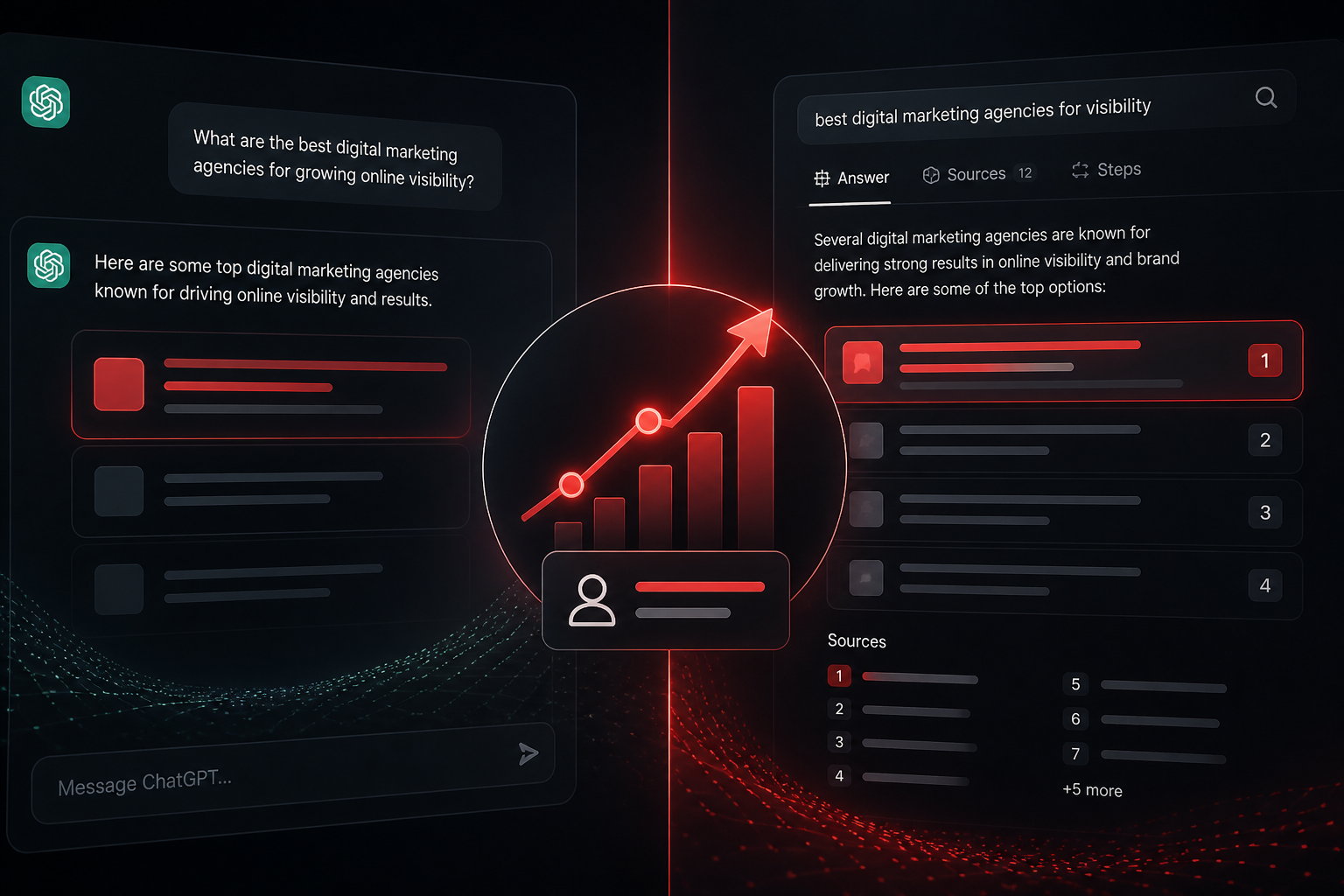
ChatGPT vs Perplexity: brand visibility differences
Both platforms offer AI-powered search, but source selection, crawler behavior, and user experience differ. You must shape your strategy around these differences.
How does ChatGPT select sources?
ChatGPT pulls sources through training data, real-time web browsing (Browse/Search mode), and Bing integration. OpenAI defines GPTBot and OAI-SearchBot crawlers. The model prefers structured, fresh content with strong topical authority on trusted domains. Pages where your brand name appears consistently with strong entity signals are citation candidates.
Visibility on ChatGPT usually drives indirect traffic: users see your brand in the answer, then run a brand search on Google or visit your site directly. Branded search growth is one of the most reliable proxy metrics for ChatGPT visibility.
How does Perplexity select sources?
Perplexity shows numbered source links in every answer, so direct clickable traffic potential is higher than ChatGPT. PerplexityBot performs real-time web search; freshness, domain authority, content clarity, and paragraphs that directly answer the question stand out.
Sentences with statistics, pages offering original data, and professional or academic tone are cited frequently. First-party guide content with a visible "last updated" date has an advantage on Perplexity.
| Feature | ChatGPT | Perplexity |
|---|---|---|
| Source display | In answer or Browse mode | Numbered source links |
| Crawler | GPTBot, OAI-SearchBot | PerplexityBot |
| Traffic potential | Indirect (branded search) | Direct clicks |
| Priority signal | Entity authority, topical depth | Freshness, clear answer format |
| Measurement | Prompt audit, branded search | Citation rate, referral traffic |
Core GEO principles apply on both platforms; the difference is priority order and measurement metrics. For the broader picture, read our Is SEO Dying? AI Search Era guide.
A practical rule: in a Perplexity-focused strategy, freshness and extractable format take priority; in a ChatGPT-focused strategy, entity authority and topical depth lead. Brands targeting both platforms serve the same content with two optimization layers—shared technical infrastructure, different content prioritization.
How to measure brand visibility
In the AI search era, "how many clicks did we get?" alone is not enough. Measuring ChatGPT and Perplexity visibility requires a new KPI set.
- Share of model: Your brand's share in AI answers for your target prompt list. For example, in how many of 10 answers to "digital agency Istanbul" does Mizemedia appear?
- Citation rate: How often your brand or content is shown as a source on Perplexity.
- Branded search trend: Brands seen in AI answers often show rising brand search volume on Google.
- AI referral traffic: Sessions from ChatGPT, Perplexity, and similar sources in GA4 (still low volume but high intent).
- Prompt coverage: Percentage of your target query set where you appear on at least one platform.
In Mizemedia GEO projects, we create industry-specific prompt lists for clients and deliver monthly citation audit reports. For a free starting point, use the visibility test on our AI Search Optimization landing page.
The most common measurement mistake is looking only at organic traffic. ChatGPT visitor volume is still low but intent is high—users come to your site after seeing your brand in an AI answer. Tracking this traffic as a separate segment in GA4 is the clearest way to understand GEO ROI. Branded search growth is an indirect but strong signal: brands seen in AI answers typically see Google brand search rise within 3–6 months.
Technical infrastructure: crawler, schema, and entity SEO
No matter how strong your content, visibility is zero if AI bots cannot access your site. Technical infrastructure is the foundation of GEO—in Mizemedia GEO audits, this layer is the first item on the standard checklist.
AI bot robots.txt policy
Manage GPTBot, OAI-SearchBot, PerplexityBot, and Google-Extended rules in your robots.txt consciously. Full blocking closes AI search visibility. Apply separate disallow rules for sensitive pages (admin panel, preview, personal data); keep blog, service, and solution pages accessible.
You can also publish an llms.txt file to tell AI systems which pages are priority. This file is not yet a standard, but early adopters gain an advantage.
Schema markup and structured data
Apply Organization, Article, FAQPage, BreadcrumbList, and LocalBusiness schema in JSON-LD format. AI systems rely on structured data to parse content—it matters as much as plain text. Article schema on every blog post and FAQPage schema in FAQ sections are now essential.
Entity SEO: define your brand as an entity
AI models think in entities, not keywords. Your brand name, industry, location, and services must be defined consistently:
- Corporate identity via Organization schema
- Clear brand definition on About page
- sameAs links (LinkedIn, social, industry directories)
- NAP (Name, Address, Phone) consistency across platforms
- Topical cluster via internal link network (this post is part of the Artificial Intelligence category cluster)
Technical SEO fundamentals—Core Web Vitals, mobile compatibility, index issues, HTTPS—apply to AI crawlers too. Slow or broken sites are crawled inefficiently. Our SEO solutions strengthen this infrastructure.
Content strategy: formats AI can cite
ChatGPT and Perplexity prefer extractable content formats. Produce structured, answer-focused content instead of long wall-of-text articles.
- Answer-first paragraphs: Give a direct answer in the first 40–60 words of each H2. This paragraph is a citation candidate for AI.
- Question-format headings: "What is X?", "How to do X?"—AI models match question-answer pairs easily.
- Numbered lists and tables: Comparison, step-by-step guide, and checklist formats increase citation rates.
- First-party data and statistics: Original data points like "Mizemedia GEO projects show an average 34% citation rate increase" create authority signals.
- Freshness: Keep publish and update dates visible. Perplexity especially shows recency bias; content older than 6 months loses ground.
- Topical authority: One article is not enough—build depth with pillar guide + cluster articles. Our Enterprise AI Solutions Guide is the pillar content for this cluster.
Integrate content strategy with our AI solutions and GEO solutions; website, blog, and service pages must speak with the same entity and message.
Content calendar recommendation: at least 1 GEO-focused blog post per month, 1 pillar update per quarter, and a comprehensive entity/schema audit every 6 months. This rhythm delivers sustainable visibility against Perplexity's recency bias. Updating existing blog posts to answer-first format—without opening new URLs—delivers quick wins.
External authority and ecosystem signals
About 80% of GEO is strategic positioning and ecosystem presence; on-site optimization alone is not enough. AI models treat brand mentions in third-party sources as authority signals.
- Digital PR: Brand mentions in industry publications, news sites, and expert blogs—with or without links.
- Reddit and forum presence: ChatGPT and Perplexity frequently reference Reddit as a trusted source. Valuable contributions in industry subreddits build authority.
- YouTube and video content: Especially Gemini and ChatGPT can use video transcripts as sources.
- Industry directories and review platforms: G2, Clutch, Google Business Profile—entity signals for B2B brands.
- LinkedIn thought leadership: Content on founder and expert profiles strengthens the brand entity.
At Mizemedia we run digital PR and entity mention strategy as an integral part of GEO projects. Our GEO optimization service page details this integration.
Especially in B2B and corporate services, potential customers ask ChatGPT and Perplexity queries like "agencies that provide X service" or "digital agency for X industry" before purchase. Not appearing in these queries means loss at the top of the sales funnel. External authority signals—industry publication mentions, LinkedIn thought leadership, customer references—directly increase citation chances in these queries.
Mizemedia implementation notes
Since 2009 as an Istanbul-based 360° digital agency, we run web design, SEO, Google Ads, social media, and AI automation under one roof. Standard deliverables for ChatGPT and Perplexity brand visibility projects:
- GEO audit: AI bot access, schema, entity consistency, content extractability assessment
- Entity mapping: Brand, product/service, and industry entities defined via schema + content
- Target prompt list: Industry-specific set of 50–100 queries; monthly citation tracking
- Content optimization: Converting existing pages to answer-first format
- Topical cluster plan: Pillar + cluster blog and service page architecture
- Integrated reporting: Organic SEO + AI citation KPIs in one dashboard
Visit our AI Search Optimization page for a free AI visibility test, or get a quote directly.
10-step implementation checklist
- Check GPTBot, OAI-SearchBot, PerplexityBot access in robots.txt—keep general content open
- Apply Organization + Article + FAQPage schema (JSON-LD)
- Clarify brand entity definition on About page; add sameAs links
- Convert top 5 service/blog pages to answer-first format
- Create a target query list of 50 industry-specific prompts
- Run monthly citation audits on ChatGPT and Perplexity; record results
- Track branded search trends in Google Search Console
- Plan at least 2 digital PR / industry mention actions (quarterly)
- Topical cluster: publish 1 pillar + 3 cluster articles
- Publish
llms.txt; list priority pages
Frequently asked questions
Can my brand appear in ChatGPT?
Yes. With GPTBot and OAI-SearchBot access allowed, structured and fresh content with strong topical authority—supported by entity SEO and digital PR—increases the chance of being cited in ChatGPT answers. Browse/Search mode pulls web sources via Bing integration.
Is Perplexity brand visibility different from SEO?
Partly. Perplexity performs real-time web search and provides numbered source links, so organic index and freshness directly matter. ChatGPT combines training data, crawling, and retrieval layers. On both platforms, entity authority, structured content, and external mention signals are critical.
Should I block AI bots in robots.txt?
Generally no. Fully blocking GPTBot, OAI-SearchBot, and PerplexityBot closes AI search visibility. Apply separate disallow rules for sensitive pages (admin, preview, personal data); keep general content accessible.
How do I measure brand visibility?
Create a target prompt list and run monthly citation audits on ChatGPT and Perplexity. Track share of model, citation rate, branded search trends, and AI referral traffic together. Mizemedia uses this metric set as standard reporting in GEO projects.
Which content formats get cited most by AI?
Answer-first paragraphs (40–60 word definitions), numbered lists, comparison tables, FAQ blocks, and sentences with statistics stand out. Extractable structure is preferred over long wall-of-text formats.
Should GEO and SEO run together?
Yes. SEO strengthens organic index, site authority, and technical infrastructure; GEO carries that authority into AI answers. They are overlapping layers, not competitors. See our What Is GEO and Is SEO Dying guides for detailed comparison.
How does Mizemedia support this?
Since 2009 we combine SEO and digital marketing experience with a GEO layer. Entity mapping, schema implementation, AI bot policy, target prompt lists, and monthly citation reports run in one team. Visit our GEO landing page for a free AI visibility test.
Conclusion
Brand visibility on ChatGPT and Perplexity does not replace classic SEO—it expands it. When technical infrastructure, entity SEO, answer-first content, external authority signals, and systematic measurement work together, your brand starts appearing as a source in AI answers. At Mizemedia we manage this process end to end with our SEO experience and GEO methodology.
Let's assess your brand's position on ChatGPT and Perplexity together. For GEO optimization, SEO services, or a free AI visibility test, get a quote — contact us.